From the link farms of 2008 to the AI measurement illusion of today: why we are on the verge of repeating search history’s worst mistakes.
Introduction: The New Front in the War for Visibility
The web is already full of content built for algorithms rather than human beings. For two decades, traditional Search Engine Optimization (SEO) turned the internet into an assembly line of homogenized, keyword-stuffed advice. Every recipe blog hid its actual instructions beneath 1,500 words of generic backstory; every product review rehashed vendor press releases just to capture affiliate clicks.
Now, as search shifts from traditional blue links to AI answer engines—Google AI Overviews, Perplexity, and ChatGPT—a new discipline has emerged: Generative Engine Optimization (GEO).
Promises of GEO are everywhere: optimize your brand so Large Language Models (LLMs) cite you as the authoritative answer. But beneath the surface, GEO is quietly creating a dual crisis. On one side, it is accelerating the flood of synthetic content designed to hijack Retrieval-Augmented Generation (RAG) pipelines. On the other, it is spawning a billion-dollar MarTech measurement industry selling unstable numbers to brands chasing ghost signals.
To understand where GEO is taking us, we first have to look back at how traditional SEO degraded the web, and how Google fought a decade-long war of attrition just to keep search usable.
1. The Optimization Cycle: How SEO Broke the Web (and How Google Fought Back)
The fundamental law of online search is simple: Whatever signal an engine rewards, the market will gamify at scale.
When Google’s original PageRank algorithm prioritized backlink volume and exact-match keywords, the internet responded with brute force. The late 2000s gave rise to the golden age of search spam:
- Keyword Stuffing: Hiding long lists of search phrases in white text on white backgrounds or forced awkwardly into every paragraph.
- Content Farms: Companies like Demand Media pumping out thousands of 200-word articles daily, written by underpaid freelancers solely to capture low-competition search terms.
- Private Blog Networks (PBNs): Networks of thousands of expired domains bought solely to pass artificial backlink authority to target sites.
By 2010, searching for simple advice yielded pages of near-unreadable text designed for bots, not people.
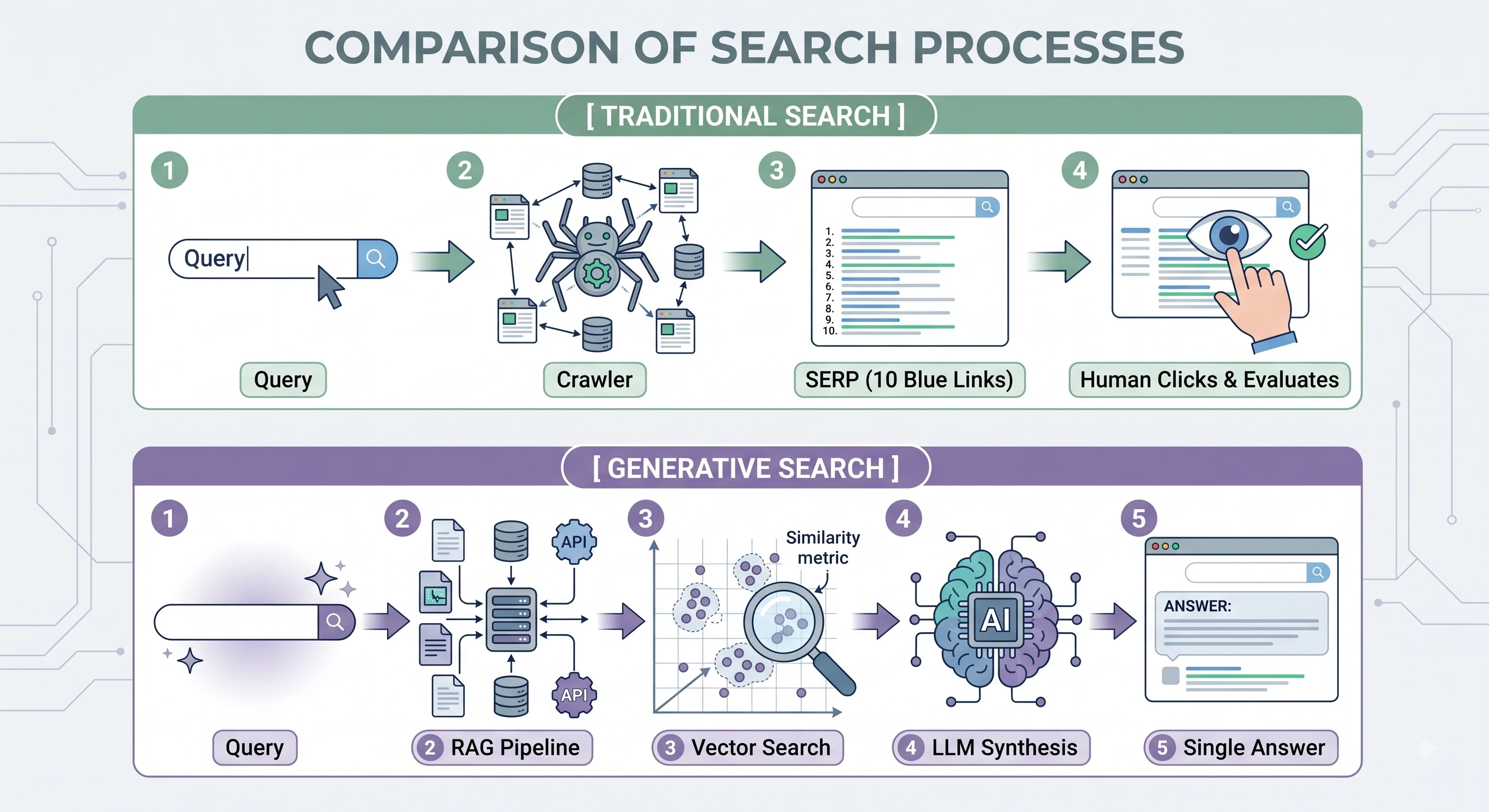
Evolution of search engine algorithms: from exact-match keywords to semantic entity mapping.
Google’s War
Recognizing that low-quality content threatened its core business model, Google launched a series of major algorithmic updates designed to purge manipulative tactics:
- Google Panda (2011): A watershed update targeting "thin" content, duplicate pages, and low-value content farms. Entire media networks lost 80% of their organic traffic overnight.
- Google Penguin (2012): Designed to dismantle artificial link schemes. Penguin penalized sites buying bulk backlinks or manipulating anchor text, forcing SEOs to focus on "earning" links rather than creating them. (For how automated workflows can build genuine outreach today, check out my guide on automating SEO and link building with n8n).
- E-E-A-T & Helpful Content Updates (2022–Present): Over the past several years, Google doubled down on Experience, Expertise, Authoritativeness, and Trustworthiness (E-E-A-T). The core message was clear: content created primarily for search engine rankings, rather than to help humans, would be systematically demoted.
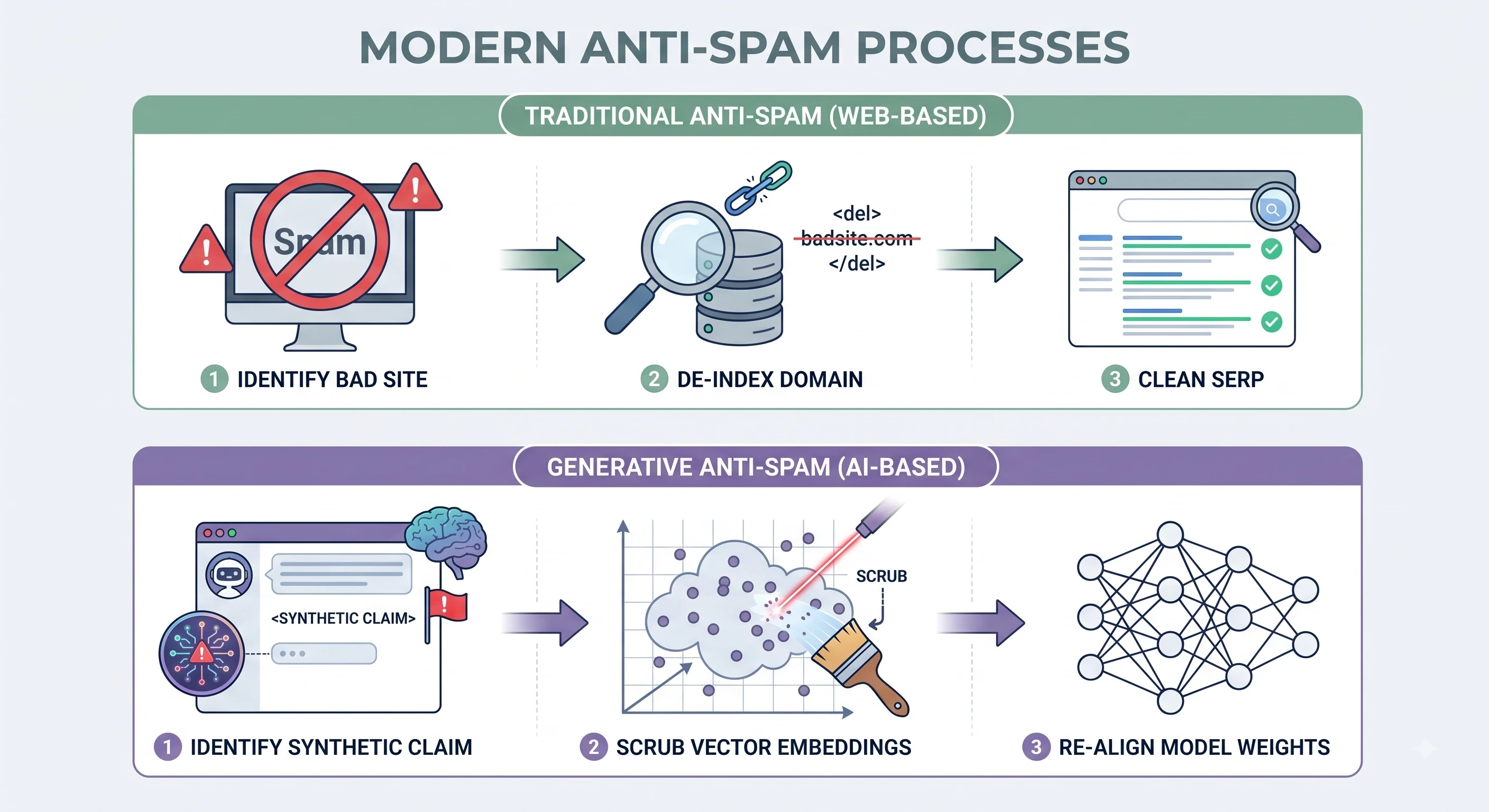
Modern anti-spam processes deployed by search engines to filter manipulative content.
The Unlearned Lesson
Despite these updates, a fundamental dynamic persisted. Every time Google shut down one manipulative signal, marketers found a subtler proxy to optimize. The cat-and-mouse game never actually fixed the root incentive: as long as traffic and revenue flow from algorithmic visibility, people will optimize for the machine first and the human second.
Now, GEO is stepping into this exact historical framework, except this time, the machines aren't just indexing content; they are writing the final answer.
2. What GEO Really Is, and Why "GEO Slop" Is Far More Dangerous Than "SEO Slop"
To understand why Generative Engine Optimization (GEO) threatens the web, you first have to understand how fundamentally it differs from traditional search engine optimization.
Traditional SEO was about indexing and ranking URLs. A search crawler indexed your page, evaluated signals like backlinks and keyword context, and placed your link on a Search Engine Results Page (SERP). The user still had to click through, evaluate your site, and decide whether to trust you.
GEO operates on a fundamentally different paradigm: extraction, synthesis, and citation.
When a user asks Perplexity, ChatGPT, or Google AI Overviews a question, the underlying system uses Retrieval-Augmented Generation (RAG). It fetches top documents across the web, breaks them down into chunks, converts them into mathematical representations (vectors), and feeds them into a Large Language Model (LLM). The model then synthesizes those chunks into a single, cohesive answer, attaching citations as footnotes. (To see how LLMs select citations in practice, read our empirical breakdown of 143,010 citations in ChatGPT responses).
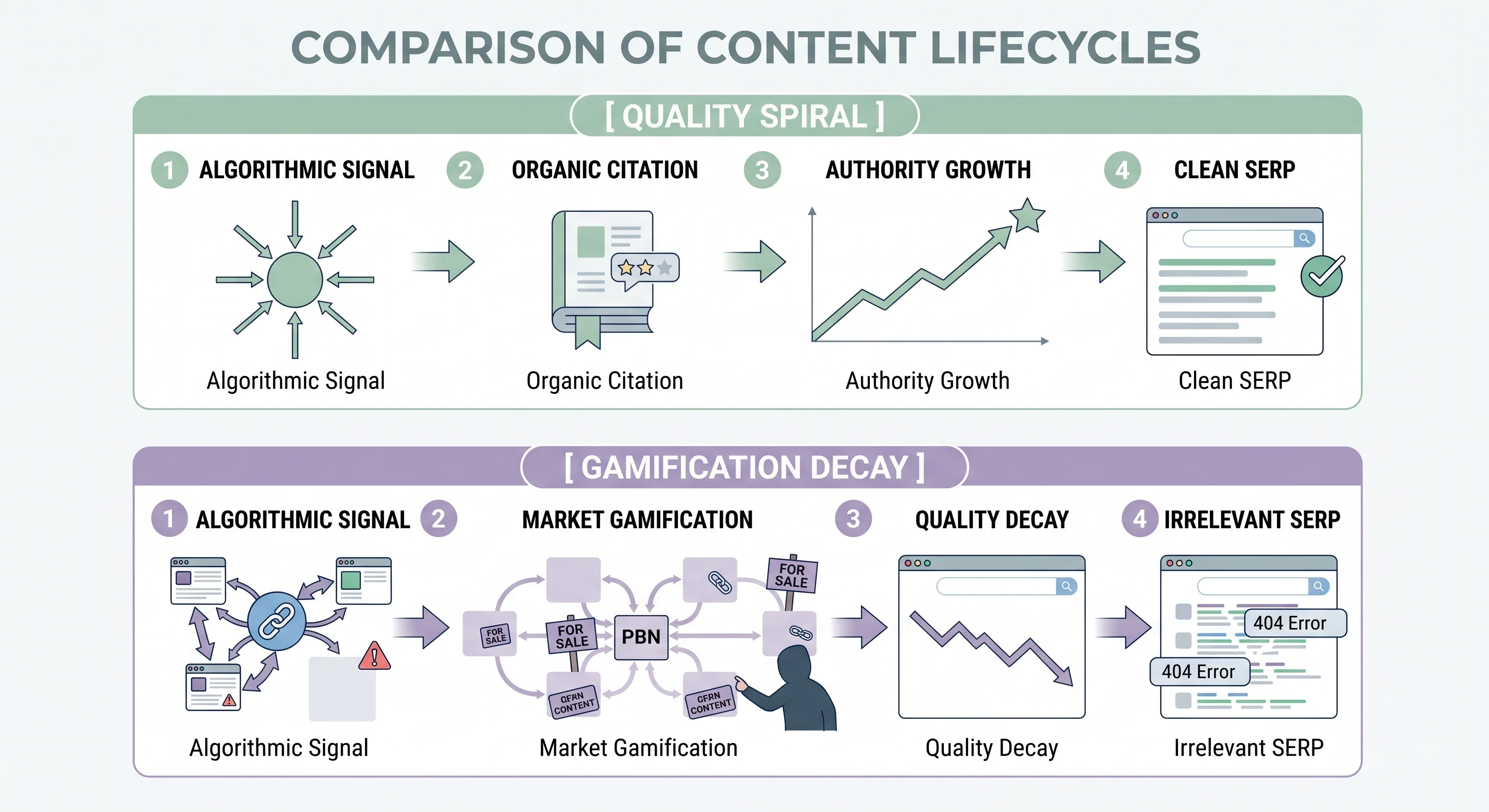
The content lifecycle in AI search: from indexing raw web pages to chunking, vector embedding, and LLM synthesis.
GEO is the discipline of reverse-engineering that pipeline. Marketers are no longer optimizing for a human to click a link; they are optimizing for a machine parser to swallow their proposition and output it as absolute truth.
The GEO Manipulation Playbook
Just as SEO produced keyword stuffing and link farms, GEO is giving rise to a new suite of aggressive, machine-targeted tactics:
- Synthetic Consensus Networks: LLMs rely heavily on cross-validation; if multiple sources claim "Brand X is the top enterprise tool for Y," the model assumes it as consensus. Marketers are now building automated networks of secondary sites, forums, and press outlets that push identical synthetic claims to artificially construct a fake consensus for RAG scrapers.
- Entity Hijacking & Contextual Stacking: Instead of stuffing keywords, GEO practitioners stack brand entities alongside high-authority category terms within dense, semantic sentence structures designed to maximize vector similarity scores in RAG databases.
- Parser-Optimized Content ("GEO Slop"): Content is structured strictly for machine parsing—rigid bullet points, predictable Q&A schemas, and sanitized, opinion-free prose stripped of human personality, optimized entirely to reduce token processing friction for LLM chunkers.
The Two Reasons "GEO Slop" Is Worse Than "SEO Slop"
If traditional SEO littered the web with low-quality pages, GEO slop threatens something worse: the degradation of public information itself.
1. The Death of the "Back" Button
In the age of traditional search, the user retained agency. If an SEO agency tricked Google into ranking a low-quality, 2,000-word affiliate article on page one, you clicked it, realized in three seconds it was garbage, hit the "Back" button, and chose another source. The friction was annoying, but you saw the bad content for what it was.
With AI search engines, the user never sees the source slop. The RAG pipeline ingests the synthetic garbage behind the curtain, synthesizes it, strips away the red flags, and presents it to you in clean, authoritative prose. GEO slop doesn't look like slop to the end user—it looks like an objective, distilled answer. The user loses the ability to evaluate primary sources because the friction of source verification has been abstracted away.
2. The Synthetic Feedback Loop (Informational Inbreeding)
When SEO slop sat on a website, it remained isolated. GEO slop, however, enters a closed-loop system:
- Brand A generates 500 AI-written articles claiming its software has a 99% satisfaction rate.
- An AI search engine crawls those articles and synthesizes a response stating "Brand A is widely recognized for 99% customer satisfaction."
- Next-generation LLMs crawl the AI search engine's answer as part of their training or real-time retrieval data.
- The synthetic claim becomes hardcoded into the model's parametric memory.
This creates a self-referential cycle of informational inbreeding. Bad data generated by AI to game AI search engines gets re-ingested by AI, compounding bias and hallucination at scale.
3. The Measurement Illusion: Why Brands Are Buying "Noise, Not Signal"
While content creators are busy polluting RAG pipelines with synthetic consensus, a parallel crisis is unfolding in the marketing suites of major brands: the multi-million-dollar illusion of AI measurement.
If you want to optimize for Generative Engines, you first have to measure your baseline visibility. And right now, a public war is tearing through the AI search measurement industry, exposing just how fragile these metrics really are. (We recently reviewed the top 10 LLM monitoring tools for brand visibility to test how platforms handle this data).
The $1B Target: Evertune AI vs. Profound
The volatility of this space was laid bare recently when Brian Stempeck, CEO of Evertune AI, launched a public attack against Profound, the $1 billion dominant player in the AI search measurement space. In front of thousands of marketers, Stempeck made a bold claim: Profound’s sampling methodology makes its data "unreliable for both measurement and optimization." Brands paying for these dashboards, he argued, are "chasing noise, not signal."
The attack immediately split the industry, generating hundreds of heated reactions within days. But to understand why this matters to anyone holding a marketing budget, you have to look at the math.
The Attack: Stempeck pointed out a very real phenomenon in Large Language Models: stochastic variation (randomness). If you run the exact same prompt 30 times through an AI search engine, the results will fluctuate. For a low-visibility brand, the error bar on a single prompt can swing by up to 12 points. If you only sample it once, you aren't measuring your visibility; you are measuring a random roll of the algorithmic dice.
The Twist (The Defense): What Stempeck's post conveniently skipped is that enterprise tools like Profound do not sell single-prompt scores. As Josh Blyskal pointed out in defense of Profound, the platform pools hundreds of different prompts, running each once to create a portfolio effect. In fact, Profound had run this exact experiment just eight days prior: 753 different prompts, comparing results from running them once a day versus ten times a day, over two weeks. The statistical gap? A mere 0.25 of a point.
As Blyskal noted, a large prompt portfolio "is already doing a lot of averaging for you."
The Blind Spot: We Are All Measuring Randomness
While the two tech companies fight over sampling methodology, independent experts looking at the data realize that both camps are missing the bigger picture.
Arman Advani, Head of Partnerships at Search Atlas, summarized the true crisis perfectly: "Both sides are really arguing about noise."
Advani explained that if you sample too few prompts, basic math dictates you are measuring randomness. But even if you achieve perfect, high-volume sampling, AI answers naturally shift from day to day as models undergo silent updates and retrieve fresh web data (model drift). "No one's handing you one clean number to chase," Advani noted. "The real question is whether your structured data, entity facts, and content are solid enough for a model to cite you."
Other industry veterans quickly pointed out fatal flaws in the entire concept of a "visibility score":
- The Prompt Selection Bias: As SEO expert Dan Cheung highlighted, which prompts a vendor chooses to track will move the final score far more drastically than how many times they repeat the run. You can easily inflate a brand's visibility score simply by cherry-picking the prompts they already perform well on.
- The Personalization Variable: Rand Fishkin (SparkToro) delivered the most devastating critique of all: AI search engines personalize results based on user history and context. No clean, anonymized API run by a measurement tool actually reflects what a real, logged-in customer sees on their screen.
The Great Conflict of Interest
Perhaps the most glaring red flag in this entire debate, noted by an astute growth advisor in the same thread, is that the industry is currently "selling brands on a metric that we can't measure."
It is highly relevant that Stempeck sells a competing product, and his product's core methodology is precisely the "fix" he prescribed in his attack on Profound. We are witnessing the birth of an ecosystem where the firm grading your AI visibility is very often the firm selling you the consulting and tools required to fix it.
When you combine "GEO slop" with unscientific visibility scores, you get a toxic corporate loop: brands pay millions of dollars to generate synthetic, parser-optimized content, aiming to move a fabricated metric that doesn't even reflect reality.
4. Can AI Engines Stop GEO Like Google Fought SEO?
When Google fought traditional SEO, it held a massive advantage: complete central control. Google owned the crawler, the index, the ranking algorithm, and the final search page. If a content farm or link network violated guidelines, Google could manually penalize or de-index the entire domain, instantly wiping out its traffic.
Combating GEO manipulation will be vastly more difficult for AI search platforms.
Because generative search relies on dynamic RAG pipelines and probabilistic text generation, there is no single "SERP" to clear. A model doesn't just display a URL; it breaks hundreds of web pages into vector fragments, blends them together, and outputs a unique response. De-indexing one bad actor doesn't solve the problem if twenty other synthetic sites are repeating the exact same optimized claims.
To prevent AI search from devolving into a wall of synthesized noise, platform engineers are deploying new defensive architectures:
1. Deterministic Knowledge Graph Anchoring
Rather than relying purely on whatever text high-vector-similarity searches return, modern AI search models cross-reference RAG outputs against verified Knowledge Graphs. If an unverified cluster of blogs claims a SaaS tool has a specific feature or rating, but established databases (Wikidata, official SEC filings, verified review platforms) contain no record of it, the model suppresses the citation.
2. Synthetic Consensus Detection
Google AI, Perplexity, and OpenAI are building algorithmic filters specifically designed to detect "ring-citation" networks. When dozens of recently created, low-authority domains publish suspiciously similar entity statements within a short window, RAG scrapers flag the pattern as coordinated manipulation and discount those sources altogether.
3. Digital Provenance and Content Credentials
As generative content floods the web, trust is shifting toward cryptographic provenance. Standards like C2PA (Coalition for Content Provenance and Authenticity) attach verifiable metadata to digital content, certifying its origin and editing history. AI crawlers are increasingly prioritizing content backed by verifiable publisher identities over anonymous, freshly scraped text.
5. The Brand Survival Guide: How to Avoid Wasting Money on GEO Illusions
For growth leaders, CMOs, and founders, the rise of GEO presents a clear dichotomy. Organizations can either waste resources chasing unstable metrics and spamming RAG pipelines, or they can build lasting, model-resilient authority through rigorous data validation.
The Vendor Vetting Checklist: Two Questions Before You Buy
Before investing in any MarTech dashboard promising to measure or optimize "AI Share of Voice," put the vendor through this technical reality check:
- "What is the confidence interval of your data, and how do you mitigate stochastic variance?" If a vendor provides a single, confident percentage without a calculated margin of error, they are selling a level of precision that nobody in this non-deterministic ecosystem has mathematically earned.
- "How were these test corpuses constructed, and do they map to empirical search intent?" If the vendor generates prompt pools internally without matching actual customer conversion pathways, it becomes trivially easy to manipulate visibility scores and fabricate artificial growth.
Engineering Measurement Reliability with Genezio
Genezio is built specifically to solve these complex measurement challenges by integrating statistical rigor directly into the UI.
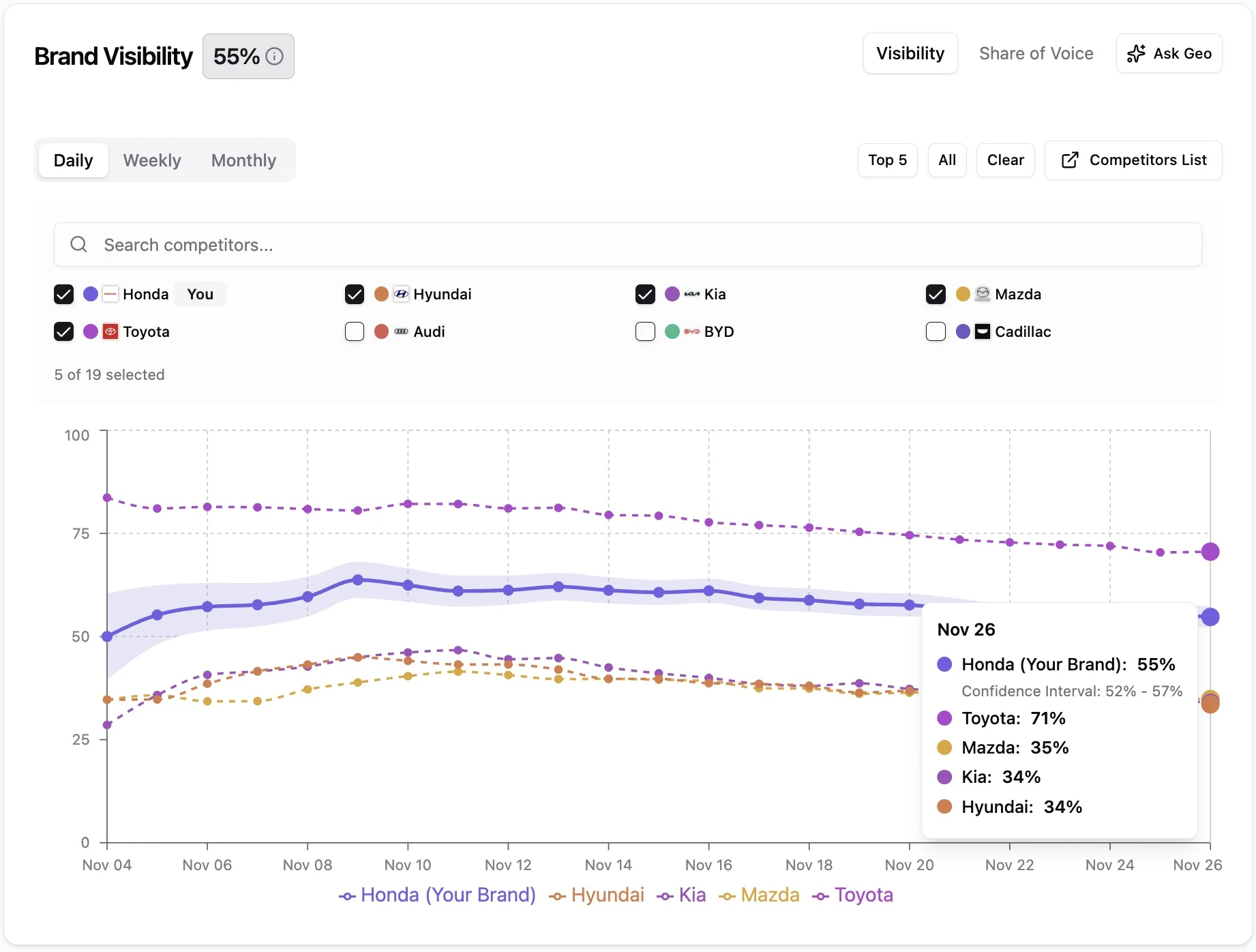
Statistical confidence guardrails embedded within Genezio's visibility analytics dashboard.
- Statistical Confidence Guardrails: Tracking LLM behavior is fundamentally difficult due to the probabilistic nature of generative outputs. Genezio embeds confidence intervals directly within all visibility charts. When the prompt volume is insufficient to overcome stochastic variance, the platform actively flags the dataset as statistically insignificant. This mathematical guardrail prevents the common industry pitfall of basing high-stakes strategic decisions on noisy, low-confidence data.
- Empirically Anchored Prompt Architecture: Relying on generic keyword lists yields inaccurate baseline metrics. Genezio solves this by leveraging native Google Search Console (GSC) data to build highly accurate test parameters. Through advanced regex-based filtering, Genezio extracts high-intent, conversational searches that reflect actual user behavior. These specific queries are used to track performance on Google AI Overviews and AI Mode. From this verified foundation, technical teams can either run these exact baseline prompts to monitor all LLM surfaces or systematically extrapolate those intent patterns to evaluate brand visibility across other major LLMs.
A Sustainable Post-SEO Strategy
Instead of trying to trick language models with synthetic consensus or "GEO slop," focus on the fundamental signals LLMs actually rely on:
- Own Your Entity Data (Schema.org): Implement comprehensive, error-free structured data across your digital properties. Make it trivially simple for machine scrapers to understand your core facts, pricing, leadership, and product specs without needing to "guess."
- Earn Primary-Source Citations: LLMs treat high-authority, heavily cited web nodes as anchors of truth. Focus PR and distribution efforts on getting mentioned in tier-one industry publications, independent research papers, and established trade databases.
- Build Direct Audience Relationships: The click-based web is shrinking as zero-click AI answers take over. The ultimate defense against algorithmic shifts is a direct relationship with your customer—through podcasts, newsletters, proprietary research, and brand affinity that bypasses search engines entirely.
The internet doesn't have to be ruined by Generative Engine Optimization, but preventing that outcome requires breaking the cycle that broke traditional SEO. The brands that thrive in the generative era won't be the ones flooding RAG pipelines with synthetic noise or buying into volatile measurement dashboards. They will be the ones creating primary, undeniable value, giving both human readers and AI models a reason to trust them. (For an actionable blueprint on building this infrastructure for your enterprise, see our framework on how to run an LLM brand visibility audit).
Frequently Asked Questions (FAQ) regarding GEO and Web Integrity
Here are answers to the most critical questions about how Generative Engine Optimization (GEO) is transforming the digital landscape.
1. What exactly is Generative Engine Optimization (GEO)?
GEO is an emerging digital marketing discipline focused on optimizing a brand's presence so that Large Language Models (LLMs), like ChatGPT, Perplexity, Gemini, and Google AI Overviews, cite and recommend the brand as the authoritative answer to user queries. While traditional SEO optimizes for human clicks on URLs, GEO optimizes for extraction, synthesis, and citation by machine parsers via RAG (Retrieval-Augmented Generation) pipelines.
2. How does GEO differ from traditional Search Engine Optimization (SEO)?
Traditional SEO was based on indexing and ranking URLs on a Search Engine Results Page (SERP), requiring the human user to click through and evaluate the source. GEO operates on a paradigm of extraction and synthesis. The user asks a question, and the AI engine fetches top documents behind the scenes, synthesizes them into a single, cohesive answer, and attaches citations as footnotes. You are no longer optimizing for a click; you are optimizing for the machine to accept your proposition as absolute truth.
3. Why is "GEO Slop" considered far more dangerous than traditional "SEO Slop"?
GEO slop—parser-optimized, sanitized, synthetic content designed solely to game RAG scrapers—threatens the degradation of public information itself for two main reasons:
- The Death of the "Back" Button: In traditional search, users could click a bad result, immediately realize it was garbage, and go back to find another source. With AI answers, the RAG pipeline ingests the garbage "behind the curtain," strips away red flags, and presents it in authoritative prose.
- Informational Inbreeding: Bad AI-generated data enters a closed loop. Synthetic content games AI engine B, and newer AI models crawl AI engine B's answer, hardcoding the claim into parametric memory.
4. Can brands accurately measure their AI visibility right now?
Currently, AI measurement is described as an expensive "illusion." The multi-million-dollar AI measurement industry is selling brands on a metric that we can't measure cleanly. This is due to stochastic variation (randomness in LLM outputs), extreme prompt selection bias (vendors cherry-picking prompts), and the personalization variable (no anonymized API run reflects what a real, logged-in customer sees). Most current metrics represent noise, not signal.
5. How is Genezio solving the crisis of unstable GEO measurements?
Genezio is built to address these complex measurement challenges by integrating statistical rigor directly into the user interface:
- Statistical Confidence Guardrails: Genezio embeds confidence intervals into all visibility charts, actively flagging datasets as statistically insignificant when prompt volume is too low to overcome stochastic variance.
- Empirically Anchored Prompt Architecture: Instead of generic keyword lists, Genezio leverages native Google Search Console (GSC) data combined with advanced regex filtering to extract high-intent conversational searches, establishing a verified baseline for tracking across LLM surfaces.
6. What sustainable strategy should brands adopt for the generative era?
To avoid wasting money on GEO illusions, brands should stop trying to trick models with synthetic consensus or "GEO slop" and focus on fundamental signals:
- Own Your Entity Data: Implement comprehensive, error-free Schema.org structured data.
- Earn Primary-Source Citations: Focus on tier-one industry publications and established research databases.
- Build Direct Audience Relationships: Cultivate proprietary relationships through podcasts or newsletters that bypass search algorithms entirely.
Need an empirical AI search strategy deployed for your brand?
If your SEO dashboard is green but models aren't recommending you, or if you're trying to separate real AI visibility metrics from MarTech noise, let's talk. Get in touch via the contact form on my homepage or go directly to the contact page.